
Chlorine taste and smell
Public suppliers have to carry a disinfectant residual to the tap. Carbon takes the taste and smell out.
Chlorine taste · Odor · Sediment
Filtration treats the water at the point it enters the house, so every tap, shower and appliance gets it — not just the kitchen. On town water the usual target is chlorine taste and smell; on a well it is sediment and iron.
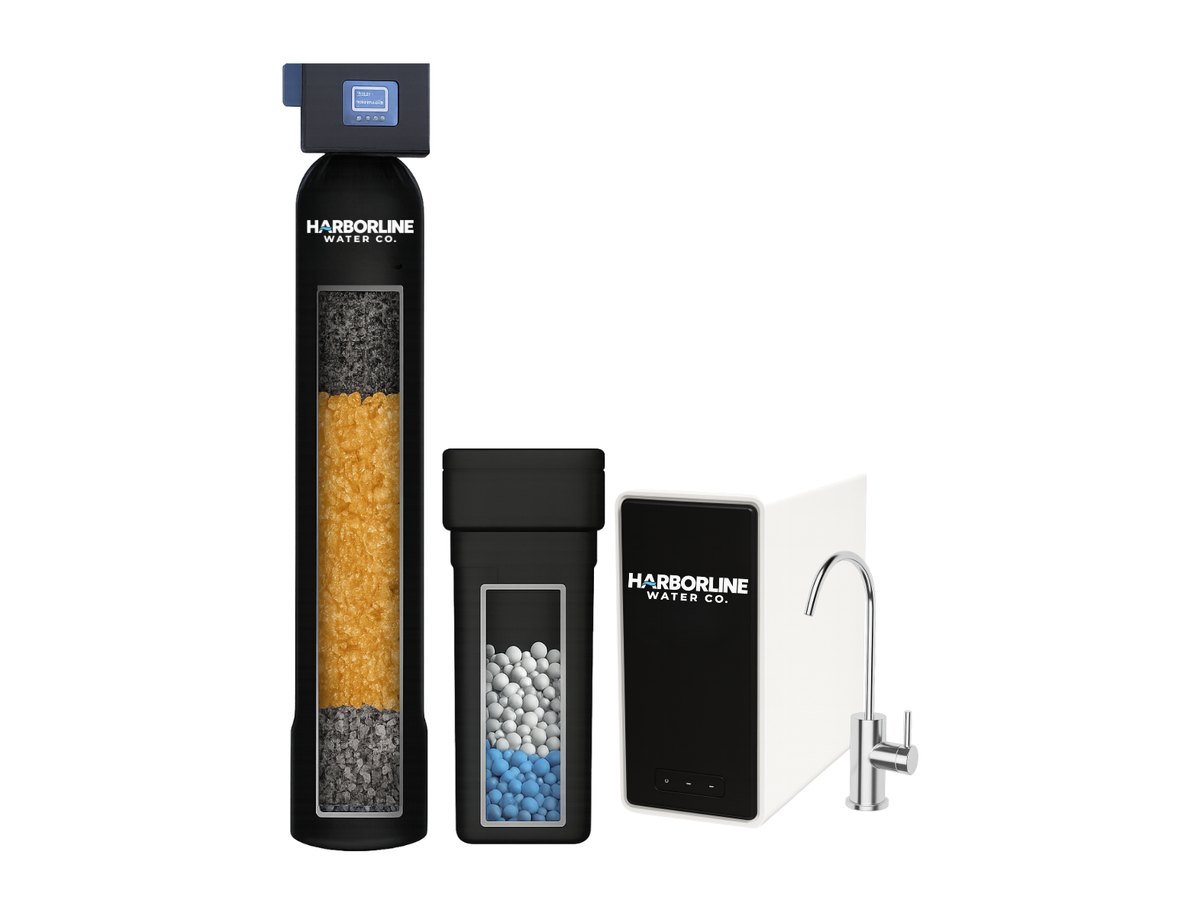
$3,295
installed, tax included — the whole-home package with drinking water at the sink
What this solves
Different water, different job. These are the things filtration at the main line actually addresses.
Public suppliers have to carry a disinfectant residual to the tap. Carbon takes the taste and smell out.
Common on wells and after main breaks or hydrant flushing on public lines. A sediment filter catches it first.
That is hardness, and it needs a softener rather than a filter. The two are usually installed together.
On public water this usually comes from old mains or the service line. On a well it is dissolved iron, which needs an iron tank.
How it works
A whole-home filter sits on the main line where water enters the house, after the meter or the well pressure tank, so everything downstream is treated.
Carbon does the work on taste and odor. In a backwashing tank the media cleans itself on a schedule and there is no cartridge to buy. In a carbon-only pass-through tank there is no drain, no power and no backwash at all.
A sediment filter goes first in the line. It is a cartridge, and it is there to protect everything behind it from sand and grit.
The equipment
Which one fits depends on what your water is doing and whether you also have hardness.
A softener and a self-cleaning carbon tank on a single valve. The common choice when you want soft water and chlorine taste gone in one system.
Carbon on its own, as a pass-through tank. No drain, no power, no backwash — for homes where taste and odor are the only complaint.
A cartridge housing installed first at the main entry, to keep sand and grit out of the tanks behind it.
Specifications are the manufacturer’s published figures. We don’t claim a system removes a specific contaminant from your water unless its published specifications support that and a test has shown the contaminant is present.
The install
Tied into the main line in a single visit.
Three-valve bypass so you can take the system offline without losing water to the house.
The carbon-only tank needs no drain at all. The dual tank does.
For the valve, on backwashing systems. The carbon-only tank needs no power.
Worth knowing
Carbon is good at chlorine, taste and odor. It is not a general-purpose contaminant filter, and we will not tell you it is.
We do not make PFAS removal claims, and we do not describe any system here as removing a specific contaminant from your water unless the equipment’s published specifications support it and a test has shown the contaminant is there. Our components — the valve, tanks and media — carry NSF certifications as components; that is not the same as a certified system, and we will not present it as one.
If you want to know what is actually in your water, a certified laboratory test is the answer, and we will tell you how to get one whether or not you buy anything from us.
Questions
It depends on what is bothering you. Public suppliers in Rhode Island and Connecticut treat and disinfect the water before it reaches you, so the common complaints are taste and smell from the chlorine residual, and scale from hardness. Filtration handles the first; a softener handles the second. If neither bothers you, you may not need anything, and we will say so.
A filter reduces things like chlorine, taste, odor and sediment. A softener removes hardness — the dissolved calcium and magnesium that cause scale and spotting. They are different jobs. Our dual tank system does both, which is why most city-water homes end up with it.
The backwashing carbon tank has no cartridge and cleans itself; the carbon media itself lasts on the order of ten years. The pre-sediment cartridge is the one you handle: check it every three to six months and change it when it looks dirty or you notice pressure dropping. On bad water that may be more often.
No. A sulfur smell needs a dedicated iron and sulfur system, which uses hydrogen peroxide injection ahead of a catalytic carbon tank. That is quoted after a consultation, because the dose depends on the water.
Probably not, and we will not sell you equipment for it. A pink or orange-pink film on chlorinated city water is usually an airborne bacteria called Serratia settling on wet surfaces, not iron in your water. Iron stains are orange-brown and they stain, rather than wipe away. Clean the pink with a bleach-based cleaner.
It improves taste throughout the house, but if drinking water is your main concern the better answer is a reverse osmosis system at the kitchen sink. It is a far finer filtration step, and it is considerably cheaper than trying to achieve the same thing for the whole house.
Often, yes. An acid neutralizer raising pH, for example, usually stays, because it helps the iron filter behind it work. We look at what is already there before recommending anything, and taking out equipment that is doing a job is not an upgrade.
The backwashing systems do — a standard outlet, drawing about a tenth of an amp. The carbon-only pass-through tank needs no power, no drain and no plumbing for a drain line.
The rest of what we do
Free water consultation
Tell us what you’re noticing. We’ll look at your water, explain what’s going on, and give you a straight recommendation and a real price — installation included.