
Orange or brown staining
In tubs, sinks, toilets and on laundry. That is dissolved iron oxidising once it hits air.
Iron staining · Sediment · Hardness
On a private well, nobody tests your water but you. There is no annual report in the mail and no supplier treating it before it arrives — which is exactly why well water is different at every address, even on the same road.
from $5,995
installed — every well is different, so the consultation sets the final number
What this solves
Southern Rhode Island and Eastern Connecticut sit on glacial sand and gravel aquifers with iron-bearing bedrock underneath. These are the symptoms that follow.
In tubs, sinks, toilets and on laundry. That is dissolved iron oxidising once it hits air.
Usually manganese, which often travels with iron and stains darker.
Hydrogen sulfide. It needs its own treatment — an iron tank alone will not fix it.
The sign that you are filtering iron with something that was never designed to, and paying for cartridges forever.
How it works
The order matters, and it is always the same: well → pressure tank → sediment filter → iron tank → softener → house. A reverse osmosis system at the kitchen sink is a separate final step for drinking water.
The sediment filter goes first so sand and grit never reach the tanks behind it.
The iron tank uses air injection over Katalox media to oxidise iron and manganese and trap them, then backwashes itself to clear what it caught. No salt, no cartridge to replace.
The softener removes hardness. It is the only part of the system that uses salt.
If an existing acid neutralizer is raising your pH, it stays — higher pH helps the iron filter work.
The equipment
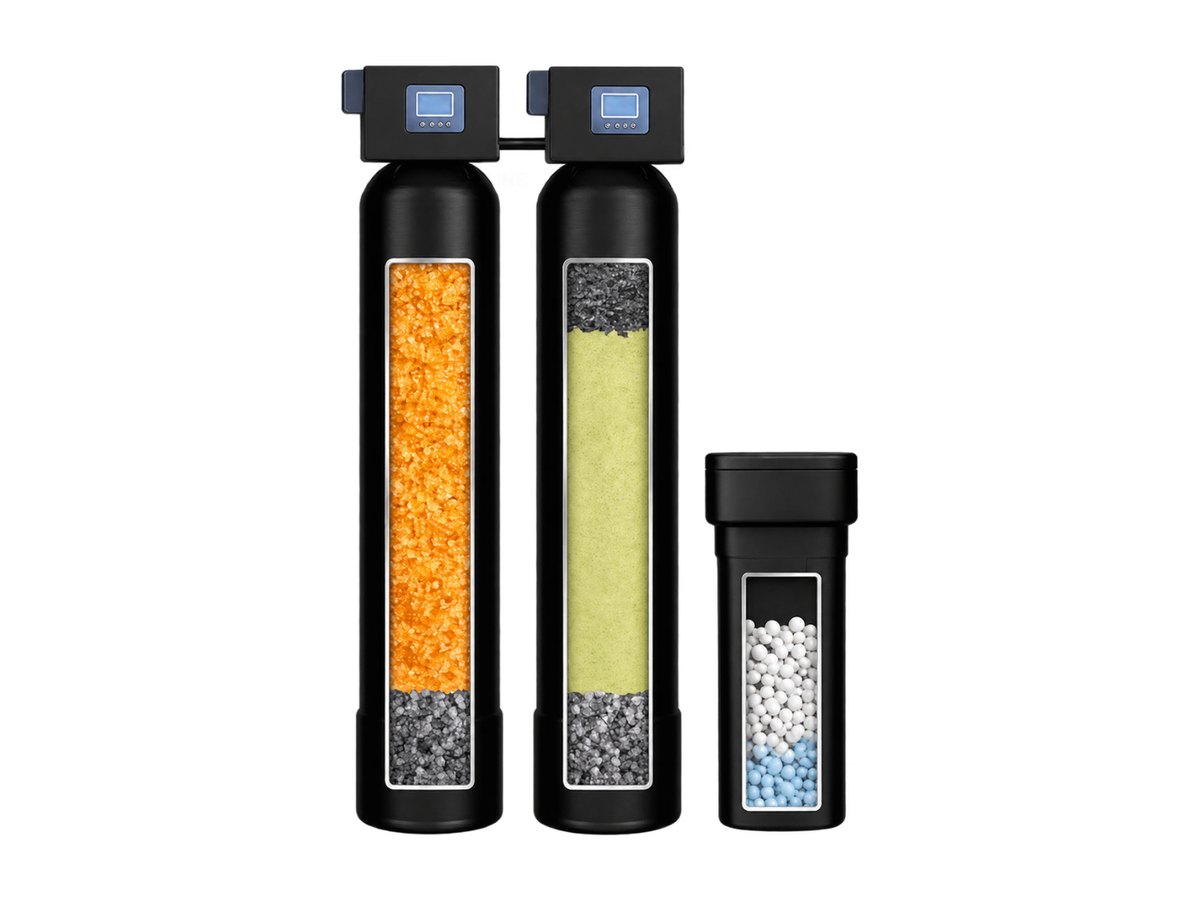
Most wells around here end up on the dual tank. Which one yours needs is settled at the consultation, not before.
A softening tank and a Katalox Light iron tank with a coconut-shell carbon layer, each on its own valve, with air injection on the iron side. This is the workhorse for iron, manganese, hardness and sediment.
For a rotten-egg smell. A hydrogen peroxide injection panel and holding tank ahead of a catalytic carbon tank and softener. Quoted after a consultation, because the dose depends on the water.
First in line, protecting everything behind it from sand and grit.
Specifications are the manufacturer’s published figures. We don’t claim a system removes a specific contaminant from your water unless its published specifications support that and a test has shown the contaminant is present.
The install
Well systems have more pieces than a city install, but it is still a single visit.
Three-valve bypass, PEX or copper, installed to code.
Both tanks rinse themselves overnight at about 3 GPM, with a code-required air gap. The laundry standpipe is the most common answer.
Ask for a four-plug outlet within six feet — two valves, and room for a drain pump if one is needed. The whole setup draws under an amp.
Worth knowing
Rhode Island. The Department of Health recommends private well owners test every year for coliform bacteria, nitrate and nitrite, color, chloride, sodium and turbidity; every three to five years for metals, corrosivity and hardness; and every five to ten years for volatile organic compounds and MTBE.
Connecticut. The Department of Public Health recommends the same annual panel and adds arsenic, uranium and radon — at least once, and ideally every five years.
We do not test for bacteria and we do not claim to treat it as a matter of course. A certified laboratory is who you want for that, and your town or state health department can point you at one. If a test comes back showing bacteria, that is a conversation about UV — and only then.
Questions
Orange-brown staining in fixtures and on laundry is the visible sign; a cartridge filter that turns rust-colored quickly is the other. How much you have is a number, and it matters: at around 1 ppm a softener on its own often handles it, and the dedicated iron tank is unnecessary. Heavier iron needs the iron tank. That is the sort of thing we would rather tell you before you spend money, not after.
Not the standard dual tank, no. Sulfur smell is hydrogen sulfide and it takes the Iron & Sulfur system — peroxide injection ahead of a catalytic carbon tank. We quote that separately after the consultation. Anyone who tells you a standard iron tank handles sulfur is overselling.
Most wells around here do not, and we do not include one by default. UV treats bacteria and viruses, so it belongs on your system when a test has actually shown bacteria, or when that is a specific concern of yours. We do not test for bacteria ourselves and we are not going to sell you a UV lamp on the basis of a maybe.
Cartridge filters catch iron until they clog, then you buy another one. The iron tank oxidises iron and manganese with injected air and backwashes itself clean, so there is nothing to replace. The only cartridge left in the system is the pre-sediment filter, and that is there to catch sand.
Rarely. The usual answer is a drain line to the laundry standpipe or utility sink with an air gap, or a new standpipe and P-trap tapped off the drain stack, or a drain pump sized for the 3 GPM backwash. Cutting a new floor drain is a bigger job, it is outside our scope, and it is almost never necessary. The plumber decides on site.
A few psi at normal household flow. The dual tank’s published 15 psi drop is at its maximum 27 GPM, and a home with everything running uses about 6 to 8 GPM. In practice people often gain pressure, because the thing that was actually restricting flow was a caked iron cartridge.
It depends what it is. An acid neutralizer raising pH stays, because it helps the iron filter. Iron reduction cartridges come out, because the iron tank does that job. We look at what is there before we recommend anything.
Salt in the softener — one to two bags every four to six weeks for a typical family. The sediment cartridge every three to six months. The iron tank cleans itself and needs nothing. If you have a UV lamp, it is replaced annually and a spare comes in the box. That is the whole list.
A softener or iron tank install is technically permittable plumbing work in Rhode Island, and in practice most installs do not get a separate permit. If you want one pulled — some homeowners do, for the record at resale — our licensed plumber pulls it and the permit cost is added. We will never tell you a permit was pulled if it was not.
The rest of what we do
Free water consultation
Tell us what you’re noticing. We’ll look at your water, explain what’s going on, and give you a straight recommendation and a real price — installation included.