
White crust on faucets and shower glass
Scale is hardness coming out of solution as the water dries. It comes back no matter how often you scrub.
Hard water · Scale · Spotting
Hard water is the most common water problem in Southern New England homes, and the easiest to prove. A softener removes the calcium and magnesium that cause scale, spotting and dry skin — and a test strip shows the difference before and after.
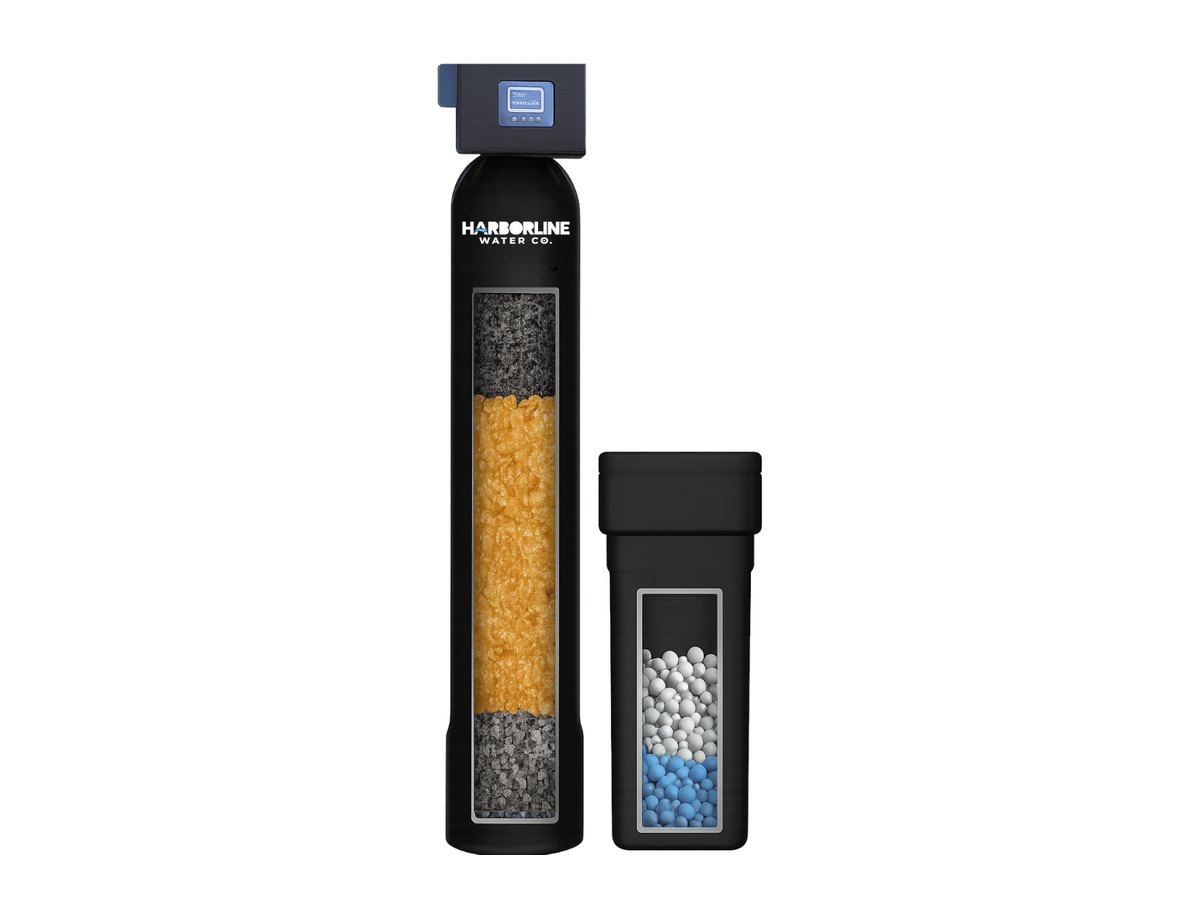
$3,295
installed, tax included — whole-home softener + kitchen drinking water system
What this solves
Hardness is dissolved calcium and magnesium. It is not a health concern — it is a cost and nuisance problem, and it compounds quietly.
Scale is hardness coming out of solution as the water dries. It comes back no matter how often you scrub.
Rinse aid masks it. It does not fix it, because the minerals are still in the water.
Hardness reacts with soap to leave a film that does not rinse clean.
Scale builds on the heating element and inside valves and cartridges, so they work harder and fail sooner.
How it works
Water runs through a tank of resin beads. The resin holds sodium; the hardness in your water swaps places with it, so what leaves the tank is soft.
When the resin is nearly used up, the valve cleans it overnight using a brine made from the salt in the second tank. That is the only time salt is involved, and it goes to drain, not to your taps.
The valve is metered, so it regenerates based on the water you actually use rather than on a timer. For a typical home that is roughly one to two times a month, usually around 2 AM, and it takes about an hour or two. You still have water while it runs.
The equipment
One system, name-brand parts, nothing proprietary — so any water treatment company or plumber can service it later.
Whole-home softener with a coconut-shell carbon layer, so it handles hardness and chlorine taste in the same tank.
Same hardware, more capacity. For larger households or higher hardness, so the system regenerates less often.
Softener plus a second self-cleaning carbon tank on one valve, when taste and odor matter as much as hardness.
Specifications are the manufacturer’s published figures. We don’t claim a system removes a specific contaminant from your water unless its published specifications support that and a test has shown the contaminant is present.
The install
A standard softener install is a single visit, not a multi-day job.
Installed to code with a three-valve bypass, in PEX or copper. Never CPVC.
The system rinses a few gallons to drain overnight at about 3 GPM, with a code-required air gap. No floor drain? See the FAQ — it is almost never a problem.
The valve draws roughly a tenth of an amp. A normal 15 A circuit is far more than enough.
Worth knowing
We sell salt-based softeners. Here is the honest comparison, including where salt-free genuinely wins.
| Salt-based softener | Salt-free conditioner | |
|---|---|---|
| Removes hardness | Yes — and a test strip proves it | No. It changes the minerals so they stick less |
| Soft-water feel | Yes | No. Water still feels and tests hard |
| Spotting and scale | Gone | Reduced scale; spotting remains |
| Needs a drain and power | Yes, both | Neither |
| Day-to-day upkeep | A bag of salt every 1–2 months | None |
| Media replacement | Resin lasts 7–12 years | About every 3 years |
| Well water | Works | Not recommended — iron and sediment foul the media |
If you flatly do not want to deal with salt and only care about scale, a salt-free conditioner is a fair choice and we will install one. We just will not call it softening, because it is not.
Questions
No. The salt never reaches your drinking water. Water flows through the resin tank; the salt in the brine tank is only used overnight to clean that resin, and the brine goes to drain. The resin does swap hardness for a small amount of sodium — roughly 8 mg per liter for each grain of hardness removed, which is very little on soft-to-moderate water. A reverse osmosis system at the kitchen sink removes most of what is left, and potassium pellets are a sodium-free alternative.
It meters your water use and regenerates when the resin is nearly spent, so it depends on your hardness and household size. For a typical home that is about one to two times a month, roughly 50 gallons to drain, usually around 2 AM. On very soft city water it is even less often, though the valve forces a regeneration at a set maximum interval to keep the resin fresh.
Almost always, yes, and you very rarely need to cut a new floor drain. The most common solution is running a small drain line to the laundry standpipe or utility sink with an air gap. The other options are a new standpipe and P-trap tapped off the drain stack nearby, or a drain pump sized for the backwash flow. The plumber makes the final call on site.
Not noticeably. The valve is rated around 25–28 GPM and a home with everything running uses about 6 to 8 GPM. Flow ratings are maximums, not settings. The usual cause of low pressure in a house with filtration is a clogged cartridge filter, not the softener.
For a typical family, one to two bags every four to six weeks; for a two-person home, closer to a bag every one to two months. Use solar or evaporated pellets, not rock salt. Check it every few weeks and top it up when it drops below about a quarter full. The first fill is loaded at install.
The resin typically lasts 7 to 12 years before it needs replacing. The tanks and dry parts carry a lifetime warranty, the control valve, circuit board and media carry five years, and installation labor carries one year. Full terms are on our warranty page.
A softener handles a small amount of iron as part of removing hardness, and on low-iron water that is often all you need. Heavier iron staining calls for a dedicated iron tank, and a rotten-egg sulfur smell needs a different system again. What your water actually needs is what the consultation is for.
A salt bridge — the salt crusts over and forms an arch, so the brine tank looks full while the system is no longer drawing brine. Break the crust with a broom handle and it resolves. That is worth checking before you call anyone.
The rest of what we do
Free water consultation
Tell us what you’re noticing. We’ll look at your water, explain what’s going on, and give you a straight recommendation and a real price — installation included.