
Rust staining in sinks and tubs
Iron in a private well is the usual cause in this part of town. Persistent, aesthetic, and treatable once measured.
Washington County · Rhode Island
North Kingstown pumps its public water out of the ground rather than down from a reservoir — and the western and southern edges of town, out toward Slocum and Saunderstown, are well country.
Water in North Kingstown
The North Kingstown Water Department supplies the developed parts of town from local groundwater wells, drawing on the aquifer system that underlies the Hunt, Annaquatucket and Pettaquamscutt river valleys. That is an unusually productive aquifer and the reason the town can supply itself rather than buying water in.
It also means North Kingstown’s municipal water is groundwater, with the mineral content that implies. Groundwater systems more often deal with iron, manganese and hardness than reservoir systems do — and the utility treats for what its wells contain before the water reaches you.
Outside the served area — Slocum, parts of Saunderstown, the roads toward the Exeter line — homes are on private wells drawing from that same ground, untreated.
Sources: Rhode Island Department of Health — Testing Your Well Water · North Kingstown Water Department · North Kingstown Drinking Water Quality Report. Figures quoted here come from the supplier’s own published water quality reporting and from state health department guidance. For the current year’s numbers, read your supplier’s annual report — they are required to publish one and you are entitled to it.
What homeowners notice
These are symptoms, not diagnoses. What is actually causing them at your address is a question for a test — but knowing what to look for is where it starts.
Iron in a private well is the usual cause in this part of town. Persistent, aesthetic, and treatable once measured.
Groundwater carries more dissolved mineral than surface water. Scale on the shower head and inside the water heater is the visible end of it.
Rhode Island's DOH lists both on its annual private well testing schedule. Wells near heavily salted roads are the ones worth watching.
Rotten-egg smell, usually stronger on the hot side. Worth ruling out rather than living with.
Two different starting points
On the North Kingstown Water Department system, the utility treats and monitors the supply and publishes an annual drinking water quality report. What is left for a homeowner is the aesthetic layer — scale on fixtures, and what the water tastes like in a glass. Softening handles the first at the whole house; reverse osmosis handles the second at the kitchen sink.
On a private well in Saunderstown, Slocum or out toward the Exeter line, you are drawing from the same ground the town pumps from — without the treatment the town applies. Rhode Island’s Department of Health suggests private well owners test every year for coliform bacteria, nitrate and nitrite, colour, chloride, sodium and turbidity; every three to five years for metals, corrosivity and hardness; and every five to ten years for volatile organic compounds.
Every recommendation we make is based on the water conditions in that specific home. We don’t quote equipment before we understand what the water is doing.
Harborline solutions
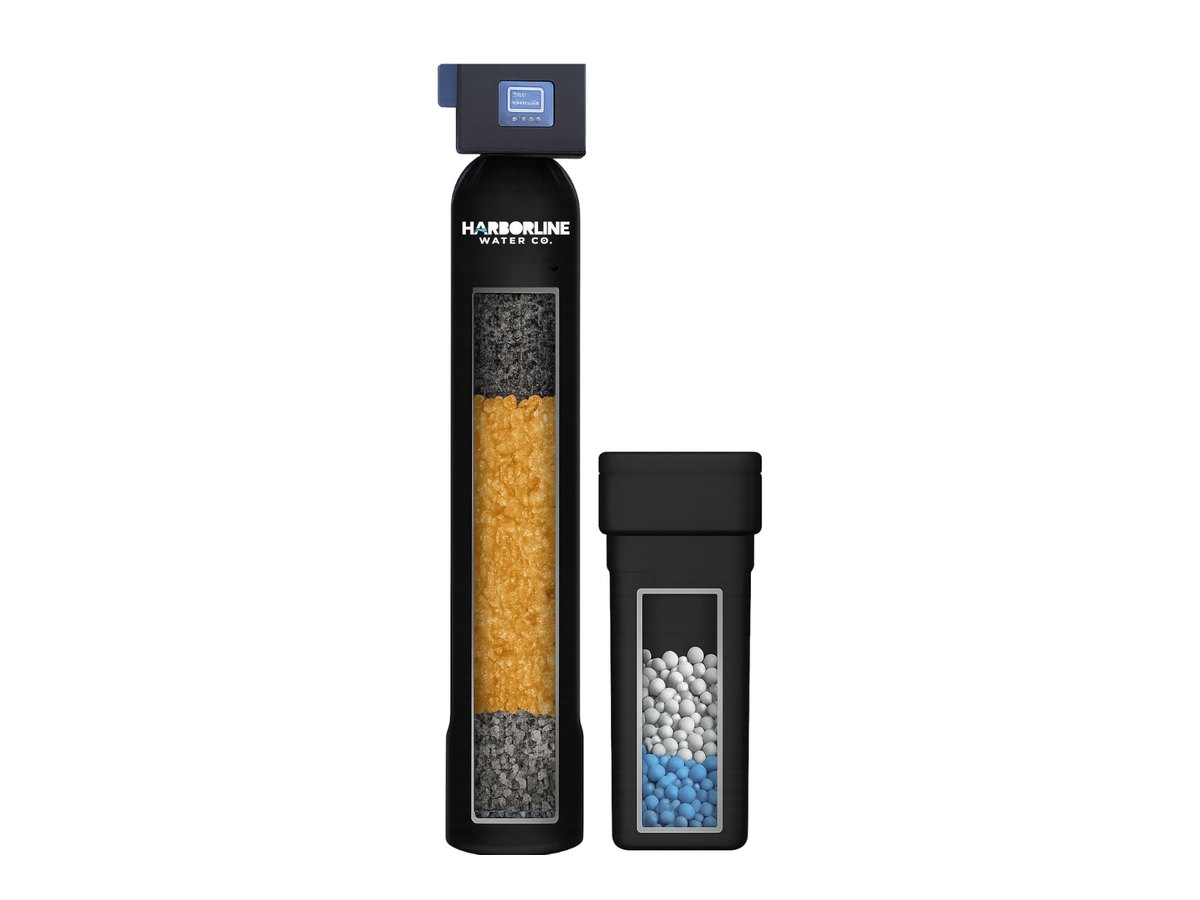
Four core systems and a set of add-ons. Which one fits depends on your water source and what a test actually finds.
We don’t claim any system removes a specific contaminant from your water. What a given system addresses depends on its actual specifications and on what your water actually contains.
How it works
Staining, smell, scale, taste — call, text a photo, or send the form.
Your water source, the conditions in the home, your plumbing and your household’s use.
A clear explanation of the problem, the system that addresses it, and the price — before any work.
Installed by us, with standard installation labour included in the package price.
You know who to call, and your warranty coverage is in writing.
Why Harborline
We work in Southern Rhode Island and Eastern Connecticut. You’re not calling a national call centre.
We look at the water before we talk about systems. Not the other way round.
If your water doesn’t need a softener, we’ll tell you that — and we do tell people that.
You get the number and the reasoning before the work, not after.
Installed by us, not handed to a subcontractor you’ve never spoken to.
Calls and texts get answered, and you know who to reach afterward.
Questions
The North Kingstown Water Department supplies the town from local groundwater wells rather than from a surface reservoir, drawing on the aquifer system beneath the Hunt, Annaquatucket and Pettaquamscutt river valleys.
Groundwater generally carries more dissolved mineral than reservoir water, so hardness is a more common conversation here than in a town supplied by surface water. For an actual number, check the Water Department's current annual report, or have your own water measured — what comes out of your tap is what matters.
The less densely developed areas outside the water department's service area — Slocum, parts of Saunderstown, and the roads toward the Exeter town line. If you do not receive a water bill from the town, you are on a well.
Iron, most likely, possibly with manganese. Both occur naturally in groundwater in this part of Rhode Island. Treatment depends on how much of each you have and in what form, which is why the test comes first.
Yes — Wickford, Hamilton, Allenton, Lafayette, Saunderstown, Slocum, Davisville and the Quonset area.
Free water assessment
Tell us what you’re noticing in your North Kingstown home. We’ll look at your water, explain what’s going on, and give you a straight recommendation and a real price.