
Water that does not taste good
The most common reason people put one in, and the one they notice every day.
Drinking water · Kitchen sink · Refrigerator
Whole-home treatment and drinking water are two different jobs. Reverse osmosis is a far finer filtration step than anything you would run on the whole house, which is why it goes at the one tap you actually drink from.
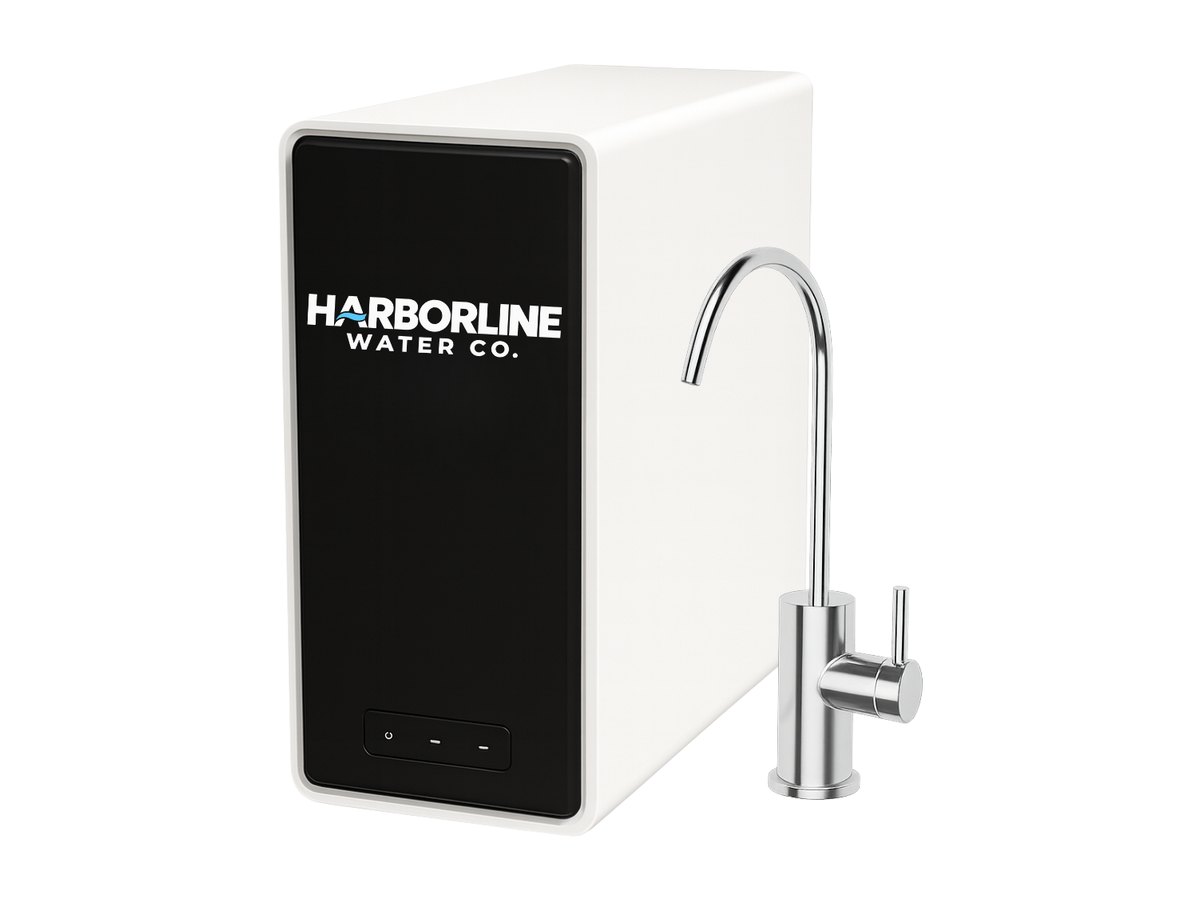
$1,195
installed — the kitchen drinking water system on its own
What this solves
The kitchen tap, specifically — drinking, coffee, cooking and ice.
The most common reason people put one in, and the one they notice every day.
An RO system at the sink is the usual reason that stops.
RO filtration is on a different order from carbon. It belongs at one tap, not on the main line.
The resin swaps hardness for a small amount of sodium. RO at the kitchen tap removes most of it.
How it works
Water passes through sediment and carbon stages, then across a semi-permeable membrane under pressure. What gets through goes to your tap; what does not goes to drain.
After the membrane the water runs through more carbon and an alkaline remineralizing stage, which puts back minerals that affect taste.
Everything fits in the cabinet under the sink. You get a dedicated faucet at the sink, and the line can feed your refrigerator as well.
The equipment
Two versions. The difference that matters is whether there is an outlet under your sink.
Seven stages, no storage tank, so it takes up much less room under the sink and there is no stored water sitting between uses. Needs a standard outlet.
A storage tank in the cabinet, and no power needed at all. The steadier choice if you are feeding a refrigerator, and the only choice if there is no outlet under the sink.
The dedicated RO faucet comes in four finishes, so it can match what is already at your sink.
Specifications are the manufacturer’s published figures. We don’t claim a system removes a specific contaminant from your water unless its published specifications support that and a test has shown the contaminant is present.
The install
Usually done alongside a whole-home install on the same visit.
For the dedicated faucet, in the finish you pick. Most sinks already have a spare opening.
Tied into the sink drain under the cabinet.
The tank-style system needs no power.
Worth knowing
You can skip the separate faucet entirely and feed the refrigerator only, or do both. Most people do both.
One practical note: a tankless system’s pump cycles on and off when it is feeding a fridge, because the fridge draws slowly. A small pressure tank smooths that out, or you use the tank-style system, which feeds a fridge more steadily and needs no outlet.
Once the fridge is running on RO water, its own internal filter gets bypassed or removed — there is nothing left for it to do. If you replace the fridge later, the line reconnects to the new one.
Questions
Check it every three to six months and change it when it looks dirty or you notice flow dropping. For most two-person households that works out to about once a year on the filters, with the membrane every two to three years.
Some goes to drain — that is how the membrane stays clean. The tankless HW800 runs at about a 2:1 ratio, which is considerably better than older systems. It is worth knowing about rather than being surprised by.
For the tankless HW800, yes. The five-stage system with a storage tank needs no power at all, which is why it is the answer when there is no outlet in the cabinet and you do not want an electrician involved.
Most of it, yes, which is why the two are usually installed together. The softener gives you soft water through the house; the RO gives you drinking water at the kitchen tap.
Yes, and plenty of people start there. It is the smallest sensible step if drinking water is your only concern, and the whole-home system can be added later.
We are careful here. The components we use carry NSF certifications as components, which is not the same as a certified system performance claim, and we will not present it as one. If you need certified reduction of a specific contaminant, tell us which one and we will show you the actual listing or tell you we cannot support the claim.
The tankless unit is noticeably smaller because there is no storage tank, so it is usually the answer in a crowded cabinet. We look at the cabinet before deciding.
If the fridge is fed from the RO line, that is RO water. The fridge’s own filter is bypassed or removed, so you stop buying those too.
Free water consultation
Tell us what you’re noticing. We’ll look at your water, explain what’s going on, and give you a straight recommendation and a real price — installation included.