
Iron staining
Orange rings and streaks that return days after cleaning. The most common well complaint we hear in rural Rhode Island.
Kent County · Rhode Island
Wooded, rural and on private wells from one end of town to the other. In West Greenwich, the question is never which utility serves you. It’s what your own well is bringing up.
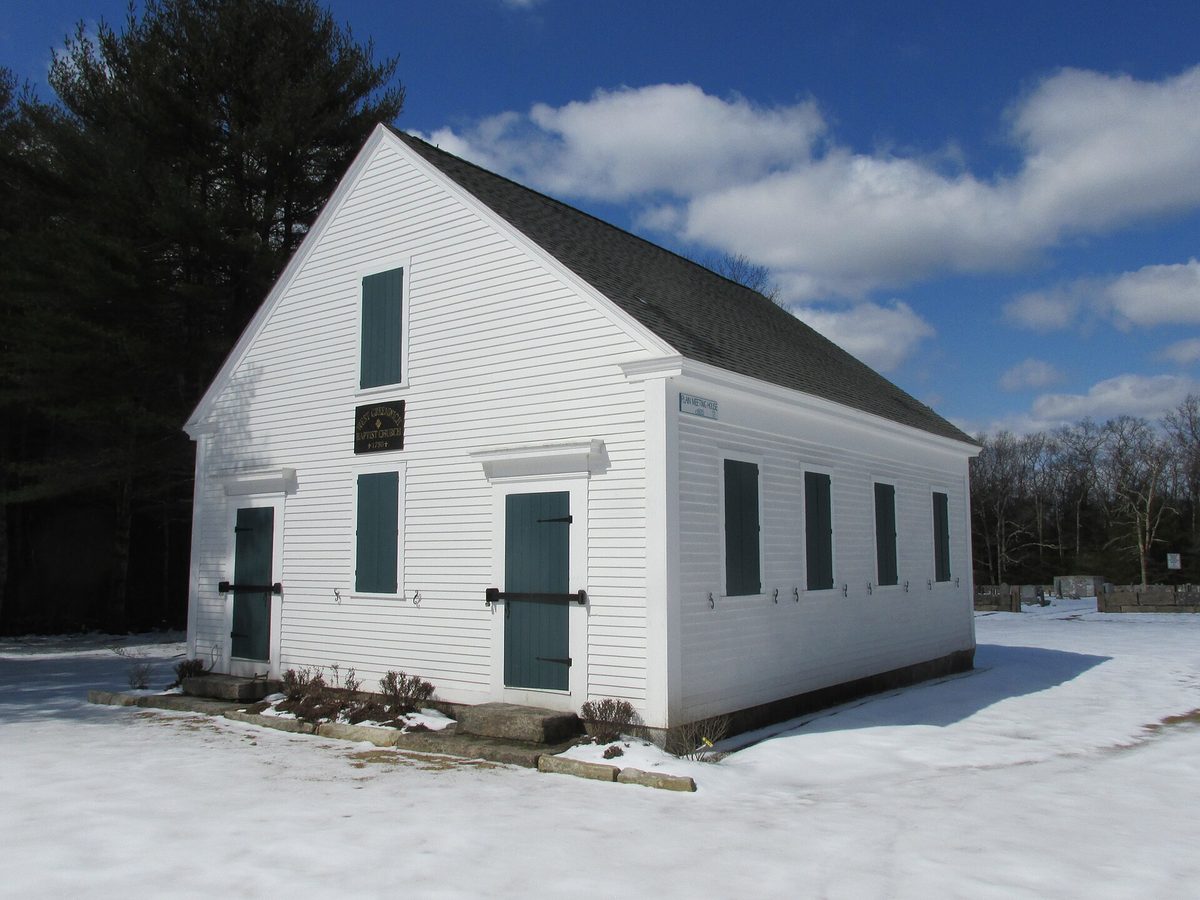
Plain Meeting House in West Greenwich. Photo: John Phelan, CC BY-SA 3.0, cropped.
Water in West Greenwich
West Greenwich has no townwide public water system. Homes here draw from private wells, from the villages of Nooseneck and Escoheag to the neighborhoods off Route 102 and Route 3. The town takes its groundwater seriously enough to keep its own well ordinance on top of the state’s drilling rules.
Wells here tap two quite different kinds of ground. Some draw from glacial sand and gravel in the valleys; others are drilled into bedrock. Bedrock wells and shallow gravel wells tend to bring up different things, so two houses a quarter mile apart can have genuinely different water.
Hardness, iron and the occasional sulfur smell are what well owners in this part of Rhode Island call us about most, and a water softener is often part of the answer. Which pieces you actually need comes from a test, not a map.
Sources: Town of West Greenwich Code — Chapter 378: Wells; Rhode Island Department of Health — Testing Your Well Water. Figures quoted here come from state health department guidance. If you are on a small community system, it is required to publish an annual water quality report and you are entitled to it.
There’s no single report for West Greenwich, because most homes here are on private wells. Public databases like EWG’s only cover public water systems, so nobody is reporting on your well unless you test it. A few small community systems do serve parts of town, and you can look them up on EWG by ZIP code →
What homeowners notice
These are symptoms, not diagnoses. What is actually causing them at your address is a question for a test — but knowing what to look for is where it starts.
Orange rings and streaks that return days after cleaning. The most common well complaint we hear in rural Rhode Island.
Darker staining than iron — near-black specks, gray laundry. Frequently found with iron in the same well.
Scale on fixtures, soap that will not lather, water heaters that wear out early. Varies well to well here.
The rotten-egg smell, often stronger on the hot side. Common enough in this area to be worth testing for.
Two different starting points
Everyone in West Greenwich is a well owner, so the whole of water treatment here starts with a test. Rhode Island’s Department of Health suggests private well owners test every year for coliform bacteria, nitrate and nitrite, color, chloride, sodium and turbidity; every three to five years for metals, corrosivity and hardness; and every five to ten years for volatile organic compounds. If your well is drilled into bedrock, it is worth asking your lab what else is worth including — deep bedrock wells and shallow gravel wells do not bring up the same things, and a treatment plan built for the wrong one is money spent on the wrong equipment.
Every recommendation we make is based on the water conditions in that specific home. We don’t quote equipment before we understand what the water is doing.
Harborline solutions
Four core systems and a set of add-ons. Which one fits depends on your water source and what a test actually finds.
We don’t claim any system removes a specific contaminant from your water. What a given system addresses depends on its actual specifications and on what your water actually contains.
How it works
Staining, smell, scale, taste — call, text a photo, or send the form.
Your water source, the conditions in the home, your plumbing and your household’s use.
A clear explanation of the problem, the system that addresses it, and the price — before any work.
Installed by a licensed plumber, with standard installation labor included in the package price.
You know who to call, and your warranty coverage is in writing.
Why Harborline
We work in Rhode Island and Eastern Connecticut. You’re not calling a national call center.
We look at the water before we talk about systems. Not the other way around.
If your water doesn’t need a softener, we’ll tell you that — and we do tell people that.
You get the number and the reasoning before the work, not after.
Installed by a licensed plumber.
Calls and texts get answered, and you know who to reach afterward.
Questions
No townwide system. Homes in West Greenwich are on private wells, and a few places, like the regional school, run small water systems of their own.
It varies, well by well. There is no town average to quote because there is no town supply, so hardness here is a property-by-property question, and the only way to answer it for your house is to measure it.
Iron, usually, and often manganese alongside it. Both occur naturally in the groundwater here. The staining is persistent, and it is treatable once the amounts are known.
Yes. If your softener is getting old, running out of soft water, or using more salt than it used to, we test your water first and tell you whether it is worth keeping or time to replace it. On a well, the softener is usually one part of a system, so the test decides what goes in front of it.
Yes, on a schedule. Rhode Island’s Department of Health recommends testing annually for coliform bacteria, nitrate and nitrite, chloride, sodium, color and turbidity, and every three to five years for metals, corrosivity and hardness.
Yes, including Nooseneck, Escoheag, Hopkins Hollow and West Greenwich Center.
Service area
Harborline serves homes across West Greenwich, RI, on public water and private wells. Not sure if we reach your street? Call or text and we’ll tell you.
Free water assessment
Tell us what you’re noticing in your West Greenwich home. We’ll look at your water, explain what’s going on, and give you a straight recommendation and a real price.